

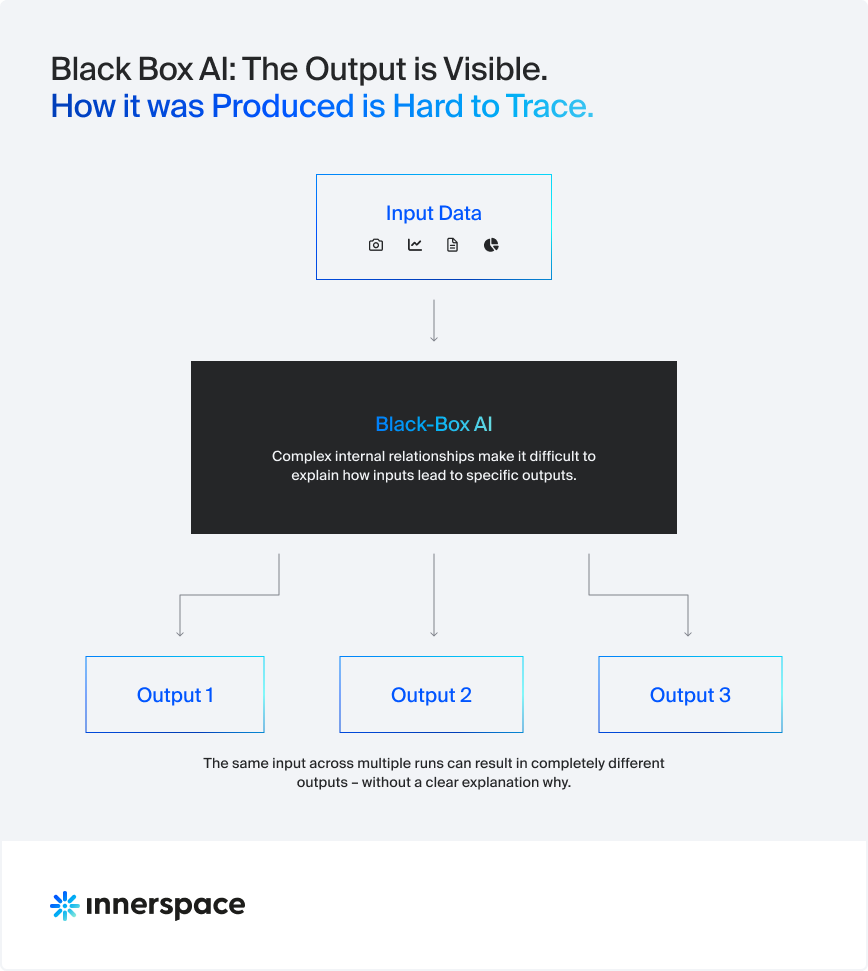
Black-box AI in GMP raises two questions. First, is the model’s decision-making process explainable? And will it give you the same output again? Draft Annex 22 asks for both, yet much of the debate stops at the second.
Vadim Smakhtin (Head of Product and Technology) at Innerspace give our assessment: where AI fits into aseptic manufacturing today, where it does not yet, and why the process data underneath matters more than the model on top.
What You Get: Key Takeaways
- Reproducible is not the same as understood: A model can be configured to return the same output every time and still be reliably wrong if it has never been given a structured description of your process.
- Annex 22 is still a draft: The published draft limits critical GMP applications to static, deterministic models. Widening that scope is under discussion but not decided, and existing GMP requirements for computerised systems and validation apply until the annex is adopted.
- Human in the loop is necessary, but not sufficient: Oversight has to be meaningful, risk-based and documented. Without the process context and the evidence behind an output, a reviewer cannot challenge it.
- Ground the process before you add AI: Describe your process clearly, quantify the risk at every step and test changes before they reach Grade A. The Frame-by-Frame® Process Model turns every interaction into structured, traceable data.
Boardroom hype meets Grade A reality
Executives want what the AI story promises: lower costs, faster scale-up of new therapies, the self-optimising smart factory. Aseptic manufacturing asks for something else: deterministic validation, end-to-end data integrity and auditability that holds up in an inspection.
Putting a generic large language model onto a sterile filling line without a validation architecture creates a compliance risk, however innovative it may look. Scilife puts it plainly: “AI can be compliant, but only when it is implemented within a validated, well-documented quality system”.1
Why plausible answers are a problem in GMP
Many modern models, large language models above all, are probabilistic. They calculate which answer is most plausible, and plausibility is something different from ground truth.
Take a realistic case. A generative assistant summarises a deviation inside an isolator and proposes a risk rating for the QRM team. The text reads well, references the right SOP and sounds confident. Ask the same question tomorrow, and the rating may differ.
“It is like rolling dice. Each roll yields a result, one that might even sound good, but the outcome is always different. A repeating result is a matter of chance, not the rule. That is definitely not the foundation upon which to build a stable process.”
Technically, many models can be configured to return the same output for the same input. That solves reproducibility, but a model can also be reliably wrong. If it has never been given a structured description of your process, consistency only means it repeats the same mistake every time. Reproducible does not mean understood.
What draft Annex 22 says, and where it is heading
Annex 22 is a proposed new annex to the EU GMP Guide on artificial intelligence. The European Commission and PIC/S published it for consultation on 7 July 2025, and the consultation closed on 7 October 2025.2 As of November 2026 it is still a draft, and EudraLex Volume 4 lists no Annex 22.3
The published draft applies to AI models in critical GMP applications that are static and deterministic. Static means the model is frozen after training and does not learn in operation. Deterministic means the same input under the same conditions gives the same output. Dynamic models, models with probabilistic output, and generative AI or LLMs should not be used in critical applications.4
Determinism alone does not open the black box. For models in scope, the draft also expects a record of which input features contributed to a result, and confidence scores, so that an output can be flagged as undecided instead of forced.5
Since then, the discussion has moved. EMA received about 1,300 consultation comments,6 and many of them supported allowing LLMs and generative AI in GMP applications, critical or non-critical. At an expert workshop on 30 June and 1 July 2026, the Annex 22 drafting group discussed widening the scope to dynamic, probabilistic and generative models, “provided they comply with the requirements of the annex and are supported by a fully documented, robust, risk-based control strategy”.7 The report, published in October 2026, records a discussion and no decision. The next step is a revised draft.8 A final text was originally expected by the end of 2026; EMA’s network planning now points to publication in early 2027.9
Our reading: whatever happens to the technology labels, the bar will not drop. The workshop found broad consensus that AI models require “documented intended use, documented understanding of uncertainties, lifecycle monitoring, risk review, and proportionate control before use in GMP applications”.10 If probabilistic models are admitted to critical applications, they will need a control strategy, and a control strategy needs a process that is understood and described in data. Until the annex is adopted, existing GMP requirements for computerised systems and validation apply.11
Human in the loop is necessary, but not sufficient
The published draft limits generative AI to non-critical applications. Even there, a qualified person remains responsible for checking that the output is suitable for its intended use.12 This is the “human in the loop” (HITL): someone who reviews AI outputs and approves decisions instead of leaving them to the system.13
We doubt that a signature alone is enough. ICH Q9(R1) stresses controlling bias,14 and a reviewer facing a confident generative answer is exposed to exactly that. The research calls it automation bias: the tendency to over-rely on automated advice, including when the advice is wrong.15 Add the operational reality. Operators rotate, shifts change, attention fatigues, and few people hold expertise in automation, fluid dynamics and aseptic technique at once.
The EMA workshop points in the same direction. Oversight should be “meaningful, risk-based and documented” rather than symbolic, and “it cannot compensate for inadequate validation”.16 The reviewer does not need to understand every internal detail of the model, but must understand “the process, the output and the decision context sufficiently to challenge the AI”.17
Approval is only as good as what the reviewer can see. Without the process context and the evidence behind an output, nobody can challenge it.
Subjectivity cannot be eliminated, but it can be controlled
ICH Q9(R1) states that subjectivity cannot be completely eliminated from quality risk management, but can be controlled by addressing bias and assumptions, using QRM tools properly and making the most of relevant data and knowledge.18 In our practice, three factors decide how well that works:
Noise. Different people judge the same situation differently, although the information is identical. Two QRM teams assign different risk levels with no objective reason. Kahneman and colleagues describe this chance variability of judgements as noise.19 One well-supported data point becomes a cloud of weakly supported ones.
Cognitive bias. Judgements are pulled in a systematic direction by assumptions, experience or expectations. A team prefers evidence that confirms its existing assessment. The result looks consistent, and consistency hides the error.
Facts and objective data. Assessments make too little use of relevant data, or ignore its quality and limits. Risk ratings then rest on opinion. ICH Q9(R1) expects “an appropriate use of evidence, science and knowledge”.20
This matters for AI directly. A model trained or tested on subjective risk ratings inherits their noise and their bias, and then repeats both at scale.
Ground the process before you add AI
Before any model, ask three questions.
Can you describe your process clearly? Are steps, critical parameters and operating limits of your filling or setup process defined and backed by reliable data? Or are you collecting “dark data”, stored but unused, costing money and creating no value? We call the answer to this question process grounding. If the data is insufficient, you are building on sand. Even a model that meets Annex 22 is only as good as the process data it was trained and tested on. Without that foundation, AI amplifies inconsistencies instead of resolving them.
Can you quantify the risk at every step? An optimisation in one step can trigger consequences downstream. What starts as an improvement can end as a patchwork of corrective measures. Risk has to become data, visible within the process, so that a local optimisation does not create a new risk for the whole.
Can you test a change before it reaches Grade A? At Innerspace we use simulation for this. Operators and engineers work through a setup, an intervention or a changed layout in the digital process model, and risks become visible while they are still cheap to fix.
“Explainability starts long before the model. If I cannot trace an AI output back to a specific step, a specific intervention and a specific risk, I cannot explain it to an inspector either. That traceability has to be designed into the data architecture from the start. You cannot bolt it onto a model afterwards.”
So which is the greater risk: the black box, or dark, inaccurate and insufficient data? Our view is that the data problem comes first, and the current Annex 22 debate makes it more pressing. The more model types regulators are prepared to accept, the more depends on the control strategy and on the process knowledge behind it. That is why we built Frame-by-Frame®.
Our answer: the Frame-by-Frame® Process Model
The Frame-by-Frame® Process Model is Innerspace’s digital process model for aseptic manufacturing. It maps a process step by step, frame by frame, and turns every interaction between personnel, equipment, materials and environment into structured data.21 A frame is the smallest observable action in the process. Each identified risk is linked to specific process steps and their data points. Assessments become verifiable, uncertainty becomes visible, and expert judgement is backed by evidence instead of opinion.
What that gives you in the context of AI:
- Traceable decisions. Every risk-based decision stays traceable from observation through risk assessment to control measure. This is the evidence a reviewer needs to challenge an AI output.
- One documented data foundation. Manufacturing, Engineering and Quality work from the same model, so any data later used to train or test an AI application has a known and documented origin.
- Audit preparedness. QRM reports, work instructions and training material are generated consistently from the same model.
The same model also supports operator training before equipment is available and the harmonisation of SOPs across lines and sites with identical configurations.22
Where generative AI does fit
AI is a tool, and its value depends on where you use it. Generative AI can help today with clearly defined, non-critical support tasks such as drafting documents, searching procedures or structuring information, with risk-appropriate controls and expert review. We support the direction of ICH Q9(R1) and draft Annex 22: intended use, validation, traceability and meaningful human oversight are sound guardrails for innovation.
Uncontrolled AI can degrade a process without anyone noticing. Generative models are built to give agreeable answers, and a reviewer under time pressure tends to accept them. The real progress lies in AI that runs on a grounded process model, built on solid digitalisation of the whole manufacturing process.
Want to know whether your process data would carry an AI validation? Talk to us. We will look at one of your aseptic processes together and show where the data is solid and where it is not yet.

About Vadim Smakhtin – Head of Product and Technology At Innerspace.
Vadim Smakhtin is Head of Product and Technology at Innerspace, where he leads the development of technology that transforms complex aseptic manufacturing knowledge into structured, scalable, and actionable insights. With more than a decade of experience in data-driven product development, he focuses on how digital process models, data, and human expertise can work together to strengthen risk-based decision-making, knowledge transfer, and operational scalability in pharmaceutical manufacturing.
Through the Frame-by-Frame® methodology, Vadim connects the Digital Process Model to expert-facing tools and workflows. The model structures interactions among people, equipment, materials, and the production environment and serves as a common data foundation for risk assessment, documentation, and training. His guiding principle: technology must fit the process, the quality system, and the responsibilities of the people who operate it – with accountable experts retaining ownership of risk and quality decisions.
- Connect with Vadim Smakhtin on LinkedIn to discuss Digital Process Models and expert-facing technology in pharma.
- Explore how to bring Frame-by-Frame® by Innerspace.eu to your facility.
Join over 1,200 pharmaceutical executives, quality managers, and manufacturing engineers who receive our newsletter. Get actionable, data-driven insights on Annex 1 compliance, human-error reduction, and digital process modeling delivered straight to your inbox.

Frequently Asked Questions (FAQ)
No. As of November 2026, Annex 22 is a draft. It was published for consultation in July 2025, and the consultation closed in October 2025. EMA is revising the text after an expert workshop in mid-2026, and current planning points to publication in early 2027, with no confirmed adoption date. Until then, existing GMP requirements for computerised systems and validation apply.
It permits AI within risk-based limits. The published draft covers static, deterministic models for critical GMP applications and says dynamic models, probabilistic models and generative AI or LLMs should not be used there. After the consultation, EMA’s drafting group discussed allowing these model types as well, provided they are supported by a fully documented, risk-based control strategy. This is under discussion and has not been decided.
A deterministic model gives the same output whenever it receives the same input under the same conditions. The draft pairs this with static models, whose parameters are frozen after training. Together the two properties make a model’s behaviour testable and reproducible during validation. They do not make it explainable, which the draft addresses separately through feature attribution and confidence scores.
A qualified, trained person reviews, verifies and approves the outputs of an AI-supported process instead of leaving decisions to the system. Approval alone is not enough. The reviewer needs to understand the process, the output and the decision context well enough to challenge or reject an output. EMA’s workshop report states that human oversight cannot compensate for inadequate validation.
A structured representation of an aseptic process that maps each step and each interaction between personnel, equipment, materials and cleanroom environment. Instead of text-based SOPs alone, it provides traceable data points that can be analysed. In Innerspace’s Frame-by-Frame® Process Model, a frame is the smallest observable action, for example “Operator A: disinfect gloves”, linked to risk-relevant information.
Sources
- Scilife: AI in the Pharmaceutical Industry: Uses, Tools & Challenges ↩︎
- European Commission: Draft EU GMP Annex 22: Artificial Intelligence, consultation version (July 2025)
GAWEL Legal: AI in Pharma Manufacturing: GMP Annex 22 and Vendors ↩︎ - Blue Squared: EU GMP Annex 22 on AI: Where It Stands and What It Means ↩︎
- European Commission: Draft EU GMP Annex 22: Artificial Intelligence, consultation version (July 2025) ↩︎
- European Commission: Draft EU GMP Annex 22: Artificial Intelligence, consultation version (July 2025) ↩︎
- EMA: Summary notes, HMA-EMA group focused on AI, industry stakeholders meeting, February 2026 ↩︎
- EMA: Report of the multistakeholder workshop on expert contributions to AI guidance development (Annex 22), EMA/156789/2026 ↩︎
- EMA: Report of the multistakeholder workshop on expert contributions to AI guidance development (Annex 22), EMA/156789/2026 ↩︎
- Blue Squared: EU GMP Annex 22 on AI: Where It Stands and What It Means ↩︎
- EMA: Report of the multistakeholder workshop on expert contributions to AI guidance development (Annex 22), EMA/156789/2026 ↩︎
- GAWEL Legal: AI in Pharma Manufacturing: GMP Annex 22 and Vendors ↩︎
- European Commission: Draft EU GMP Annex 22: Artificial Intelligence, consultation version (July 2025) ↩︎
- MDPI Information: Human-in-the-Loop AI Use in Ongoing Process Verification in the Pharmaceutical Industry ↩︎
- ICH: Q9(R1) Quality Risk Management ↩︎
- Goddard, Roudsari, Wyatt: Automation bias: a systematic review ↩︎
- EMA: Report of the multistakeholder workshop on expert contributions to AI guidance development (Annex 22), EMA/156789/2026 ↩︎
- EMA: Report of the multistakeholder workshop on expert contributions to AI guidance development (Annex 22), EMA/156789/2026 ↩︎
- ICH: Q9(R1) Quality Risk Management
Pharmaceutical Technology: Shining a Light on the Long Shadow of Subjectivity in Quality Risk Management ↩︎ - Harvard Business Review: Noise: How to Overcome the High, Hidden Cost of Inconsistent Decision Making ↩︎
- ICH: Q9(R1) Quality Risk Management
Pharmaceutical Technology: Shining a Light on the Long Shadow of Subjectivity in Quality Risk Management ↩︎ - Innerspace: Frame-by-Frame: The Digital Process Model ↩︎
- Innerspace: Frame-by-Frame: The Digital Process Model ↩︎