

Having spent over 20 years in the digital and software world and more than a decade dedicated specifically to the pharmaceutical manufacturing sector, I have developed a healthy skepticism toward industry buzzwords. Every few years, a new acronym or technological savior promised to revolutionize the shop floor. Today, it is artificial intelligence, agentic workflows, and autonomous systems.
In my previous article, “Innovation vs Regulation – how to implement Ai in Pharmaceutical Manufacturing“, we explored the high-stakes paradox of pharma AI. We discussed how an industry highly motivated to capture an estimated 350 to 410 billion dollars in annual value (as outlined by Scilife’s AI Pharma Innovation & Challenges) often ends up among the 73% of digital transformation projects that fail on the sterile manufacturing floor (a stark reality documented in William Flaiz’s analysis of why pharma digital transformations fail and broader research on biotech digitalization trends in ScienceDirect).1
This article met with keen interest across the industry, sparking some highly valuable discussions. But one question kept coming up from C-level executives and site leaders alike:
“How do we embed a standardized data foundation into facility ramp-up and production scale-up from the start?”
Bridging this divide requires a broader view of a discipline already fundamental to pharmaceutical engineering: Operational Readiness, reconsidered for an increasingly data and AI driven manufacturing environment.
In this context, Operational Readiness should not be treated as a mere final phase before start-up. It should be designed into the facility as a continuous lifecycle capability, directly connected to Quality Risk Management (QRM). By aligning process knowledge, data governance, qualification, contamination control, workforce training, and risk-based decision-making from early design through routine operation, it elevates the role of data to build deep institutional knowledge and empower teams to understand and mitigate complex risk scenarios better.
We are at an important point in the evolution of pharmaceutical manufacturing. The decisions made today about data, digital systems, and operational design will shape resilience, time to market, and regulatory performance for years to come. The opportunity is significant, but so is the cost of building on a weak foundation. When machine learning, advanced analytics and artificial intelligence are introduced on top of clean, standardized, and validated data, they can reduce startup friction, accelerate technology transfer, improve decision making, and support higher levels of Right First Time execution.
However, if we confuse technological hype with structural maturity, we simply automate bad habits and create untraceable liabilities on an unprecedented scale.
Advanced AI cannot compensate for an operational foundation that is not ready. Day One performance in a new pharmaceutical facility depends first on process understanding, capable people, reliable and contextualized data, qualified systems and effective controls. The objective should therefore not be to make a facility “AI-ready” in isolation, but to make it knowledge-ready, risk-ready and operationally ready. AI then becomes an accelerator of an already capable system rather than an attempted remedy for an immature one.
Let’s talk about how to bridge that gap.
Key Takeaways: Executive Summary
- Proactive over Reactive: Virtual workflow modeling before launch prevents years of post-launch troubleshooting and compliance rework.
- People Drive 80% of Success: Technology is only 20% of the equation; frontline culture, human behavior, and workforce capability remain the critical path.
- No More Black Boxes: EU GMP Annex 22 (draft) aims to ban dynamic models in critical tasks – every algorithm must be fully explainable, validated, and transparent.
- Eradicate Dark Data: With 80% of data decaying within 20 years, standardizing human and machine workflows into “Process DNA” is the only way to avoid the “Garbage In, Garbage Out” trap.
- Simulate to Scale: Digital process models accelerate technology transfers and slash training times through risk-free behavioral simulations.
What is Operational Readiness in Pharma in the Classical Sense?
In the traditional pharmaceutical project context, Operational Readiness can be understood as the structured, cross-functional process that ensures a facility and organization are fully prepared for safe, compliant, and reliable operations. It spans the late project and early operational phases, typically beginning during design and construction and continuing through commissioning, qualification, validation, and organizational preparation.
Ultimately, it enables the transition from a project environment to a ready-to-run operation by aligning engineering, technology transfer, operations, people, processes, systems, and data, thereby supporting successful start-up, ramp-up, and routine manufacturing. It is the structured process of ensuring a facility can manufacture its designated active pharmaceutical ingredient (API) or biological product safely, efficiently, and in compliance from tech transfer.
Historically, organizations like Commissioning Agents Inc. (CAI) have championed structured operational readiness frameworks to avoid the common pitfalls of facility startup. Their operational philosophy is outlined extensively in the CAI Operational Readiness Solution Brief.2
In the classical sense, this readiness rests on a three-legged stool:
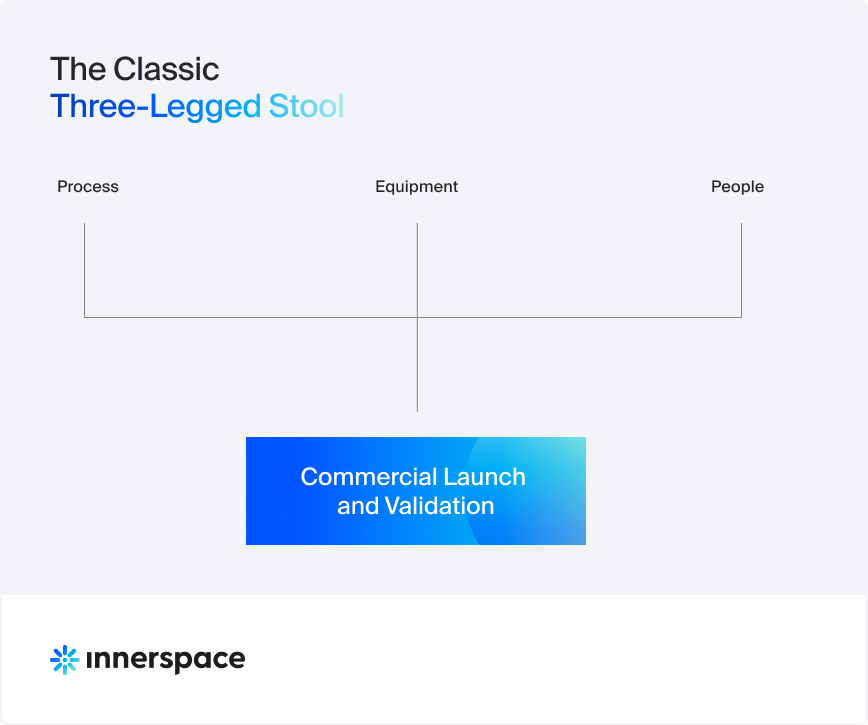
1. People – Can our people perform the operation?
A qualified team is a ready team. In classical readiness, this means ensuring operators are onboarded, roles are defined via RACI matrices, and standard operating procedures (SOPs) and instructions are approved. It means training staff to understand contamination control and cleanroom behaviors before the first batch is run.
2. Process – Can the process and control strategy be executed consistently?
This involves the mapping of every physical process step – from raw material receipt through aseptic formulation, sterile filtration, filling, and final product release. The goal is to define the critical quality attributes (CQAs) and critical process parameters (CPPs) to ensure reproducibility, minimize contamination risks, and safeguard final product quality.
3. Assets & Equipment – Can the physical systems perform as intended?
This represents the physical facility. It encompasses the comprehensive facility design, installation, testing, and maintenance of cleanrooms, HVAC systems, and production lines. It is heavily governed by Commissioning, Qualification, and Verification (CQV) processes to prove the equipment meets design specifications.
Then AI becomes the next layer, rather than another Operational Readiness pillar.
That distinction is important to not position AI itself as a readiness requirement. We would position data and knowledge readiness as the prerequisite that makes advanced analytics and AI useful, controlled and ultimately defensible in a GMP environment.
The Product Launch Reality Gap
In an ideal world, construction ends, a seamless handover occurs, and production hits maximum design throughput on Day One.
But as Fintan Coady (CQV & Operational Readiness Lead at PM Group) observes in his article on Operational Readiness in Pharma: “Readiness often starts too late. Teams tend to focus on construction and CQV, pushing readiness planning aside.”3
When readiness planning is treated as an afterthought rather than a discipline, companies suffer from a “Tale of Two Startups”:
- Option A (The Reactive Pitfall): Unresolved human and process risks remain at startup. The product launch is delayed, and the facility enters a multi-year cycle of batch deviations, costly rework, human errors, and constant compliance friction.
- Option B (The Proactive Ideal): Human, process, and asset risks are systematically addressed before launch. Processes are modelled in a structured process model, associated hazards are systematically identified, and appropriate controls are assigned to reduce risk. This enables teams to evaluate process variants, bottlenecks, and aseptic risks virtually before exposing the physical cleanroom-accelerating the path toward a stable, controlled process at maximum design throughput.
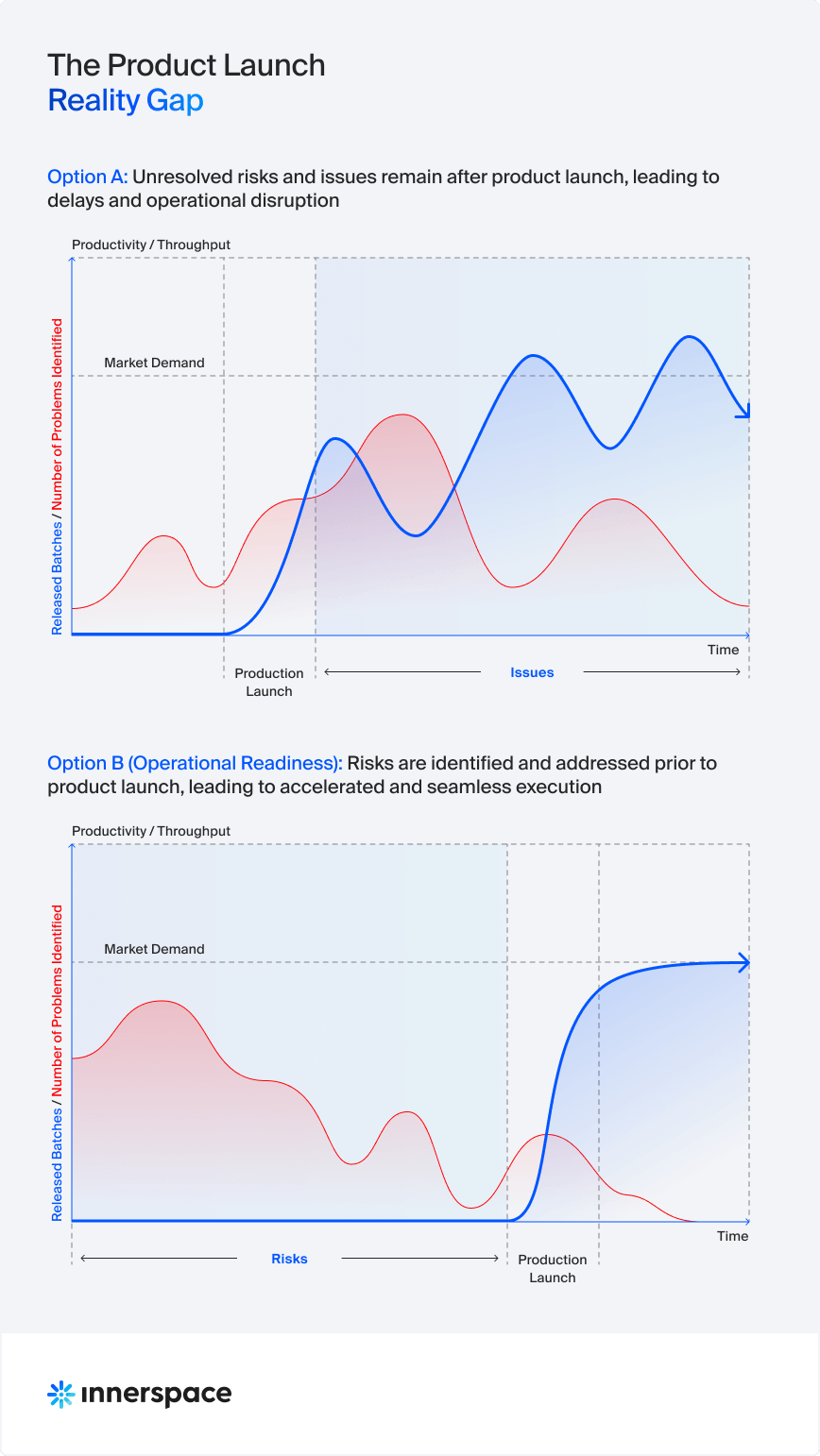
Source: “Reactive Pitfall” vs “Reactive Pitfall”
The Core Pillars of Operational Readiness in the Era of Digitalization, Data, and AI
While the classical model of Process, Equipment, and People remains foundational, the modern pharmaceutical facility is no longer purely mechanical. We have entered the era of Pharma 4.0, where a fourth dimension has integrated itself into the readiness equation: Digital & Data Enablement.
According to the comprehensive CAI Operational Readiness Framework – a framework built on CAI’s 30-year legacy of guiding life science projects through complex tech transitions – modern readiness models must evaluate maturity across six interconnected strategic pillars rather than siloed functional areas:4
- Strategy & Leadership: Unified commitment, culture, and accountability to operational success.
- Execution Excellence: Risk management, operational planning, and continuous improvement based on measurable outcomes.
- Workforce Capability: Supported, trained, qualified staff clear on their roles and ready to perform on Day One.
- Equipment & Facility Readiness: Maintenance, calibration, and engineering design aligned to manufacturing operations.
- Digital & Data Enablement: Seamless data flows, supporting systems (such as LIMS, MES, and ERP), and digital platforms built to accelerate project delivery and decision-making.
- Quality Advancement: Best-in-class, phase-appropriate regulatory compliance and quality assurance practices.
On paper, the integration looks straightforward. In practice, digital systems and AI must operate within the realities of sterile manufacturing. Without a strong process, data, and validation foundation, they can introduce new risks instead of solving existing ones.
The Collision: Where Tech Hype Meets GMP Reality on the Shop Floor
The pharmaceutical industry is currently facing a massive labor shortage and unprecedented pressure to lower the bio-availability costs of advanced biologics. Naturally, companies look to digitalization and machine learning as salvation. In fact, survey data from Forrester Consulting reveals that over 60% of pharma manufacturers are actively investing in machine learning (61%), predictive maintenance (65%), or natural language interfaces (61%) to close operational gaps.5
But as Martyn Williams, Managing Director of COPA-DATA UK, points out in his column on the digitalization of pharma and its barriers: “Digital transformation is 80% people, 20% tools.” In fact, survey data from the Pistoia Alliance reveals that more than half of life sciences professionals identify internal resistance to change and fragmented legacy systems as the number one barriers to transformation.6
When companies try to force-feed digital solutions into their operational readiness plans, they run straight into operational barriers:
1. AI Meets GMP: The Emerging Annex 22 Framework
The regulatory framework for AI in pharmaceutical manufacturing is still evolving. In 2025, the European Commission published a draft EU GMP Annex 22 (extensively discussed in the European Pharmaceutical Review’s breakdown of Annex 22), proposing requirements around intended use, data quality, validation, explainability, human oversight, and lifecycle control.7
The draft takes a cautious position on advanced AI:
- Dynamic models: Continuously learning or adaptive models should not be used in critical GMP applications.
- Generative AI and LLMs: These should not be used in critical GMP applications. For non-critical uses, qualified personnel remain responsible for assessing the output.
- Supplier oversight: Using third-party AI does not remove the manufacturer’s responsibility for documentation, validation, performance, and change control.
Importantly, Annex 22 is not yet an operative GMP Annex, and EMA is continuing to evaluate how generative, adaptive, and probabilistic AI could be used under appropriate risk-based controls.
Manufacturers applying AI in GMP environments should focus on five core principles reflected in the draft Annex 22:
These principles are derived from the requirements outlined in the European Commission’s draft EU GMP Annex 22 on Artificial Intelligence and are also summarized in IntuitionLabs’ analysis.8
- Clear Intended Use: Define the model’s purpose, process context, data characteristics, risks, and acceptance criteria before testing. The paper specifically emphasizes documented intended use and approval before testing.
- Demonstrated Performance: Establish predefined performance criteria and demonstrate that the model performs at least as well as the process it replaces. This is directly stated in the paper.
- Independent Testing: Keep training, validation, and test data appropriately separated and independently verify critical test results. This closely matches the paper’s requirements around data separation and verification.
- Explainability and Confidence: For critical applications, demonstrate sufficient interpretability and define how uncertain or low-confidence outputs are handled. The paper discusses feature attribution, confidence thresholds, human review, and fallback processes.
- Lifecycle Control: Monitor model performance and manage updates, retraining, drift, and relevant changes through formal change control and revalidation where required.
“The direction is clear: AI does not remove GMP accountability. The more critical the application, the stronger the expectations around data quality, validation, transparency, and human oversight.“
2. The GIGO Trap: When Data Lacks Operational Context
The pharmaceutical industry’s challenge is not a lack of data, but a lack of structured and contextualized data.
CAS describes this as the DRIP problem: Data-Rich, Information-Poor. Pharmaceutical organizations generate enormous amounts of information, yet much of it remains fragmented across documents, legacy systems, databases, and individual expertise. Without consistent structures and terminology, more data does not necessarily create more usable knowledge.9
For AI, this is critical. The FDA highlights data quality, data integrity, model management, and process understanding as key considerations for AI in pharmaceutical manufacturing.10
A dataset can therefore be technically complete while still lacking operational context. A sensor value may tell us what happened, but not what activity was being performed, which equipment state was present, what the operator was doing, or why the observation matters to product quality.
Without this context, AI can identify correlations that are statistically valid but operationally meaningless. This is the so-called Garbage In, Garbage Out (GIGO) problem.11
The same principle is reflected in the draft EU GMP Annex 22, which emphasizes intended use, process understanding, input-data characteristics, limitations, and potentially erroneous or biased inputs.12
AI needs more than data. It needs structured data with sufficient process context.
Subject Matter Experts remain essential because they often provide context that conventional systems do not capture. But there is an important distinction:
The problem is not keeping the expert in the loop. The problem is when the expert is the only place where the operational logic exists.
The objective should therefore be to transform tacit expertise into structured, traceable, and reusable process knowledge.
That foundation supports more reliable risk assessment, technology transfer, training, analytics, and future AI applications.
A practical test of that foundation is Technology Transfer in Pharma: can the receiving site understand the process, assess its local risks, and demonstrate capability rather than merely receive documents?
Five Structural Failure Points in Digitalizing Operational Readiness
Digital transformation in pharmaceutical manufacturing is not only a technology challenge. It depends on how well processes, data, people, and compliance are prepared to support it.
Five structural failure points stand out:
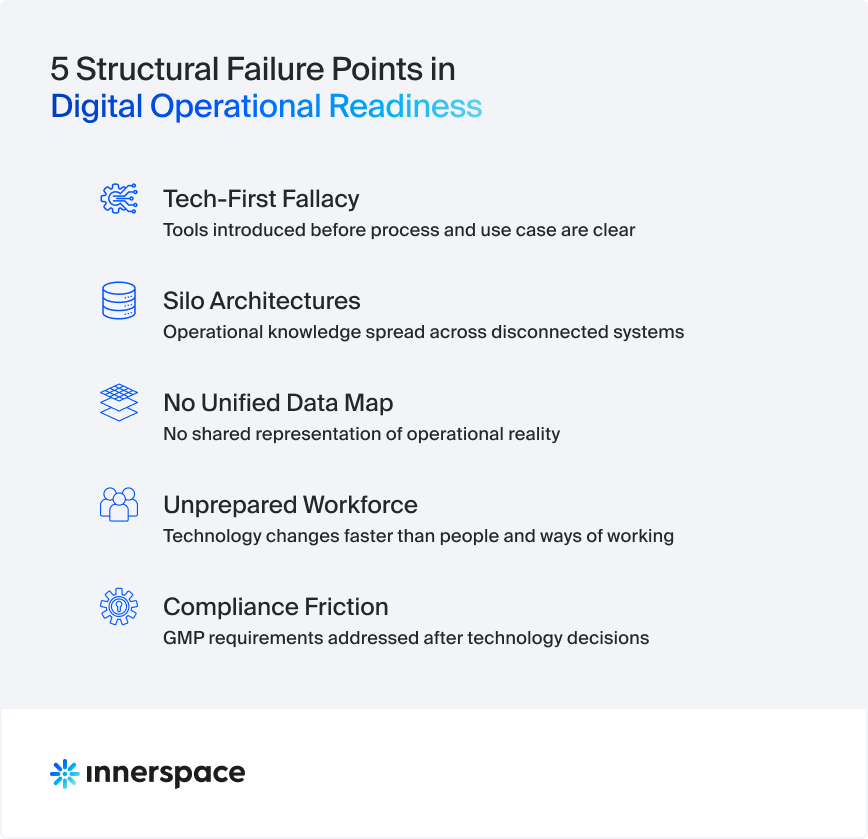
- Technology Before Process: Organizations introduce AI, AR/VR, or other digital tools before clearly defining the process problem and intended use. ISPE’s Pharma 4.0 framework emphasizes that digital transformation requires alignment between technology, processes, organization, and culture.13
- Fragmented Systems and Data: MES, LIMS, QMS, training, maintenance, and other systems often operate with different structures and terminology. The result is fragmented operational knowledge that is difficult to connect and reuse.14
- No Common Model of Operational Reality: Organizations often lack a consistent way to represent how people, equipment, materials, activities, risks, and process states interact. This becomes increasingly important for AI, where process understanding and data context are critical.15
- Unprepared Workforce: Digital transformation changes how people work and make decisions. If operators and process experts are involved too late, digitalization risks becoming an IT rollout rather than an operational transformation.16
- Compliance Added Too Late: Validation, data integrity, traceability, change control, and lifecycle management need to be considered from the beginning, not added after the technology has been selected.17
“The common denominator is clear: technology cannot compensate for the absence of a standardized operational foundation connecting process, people, equipment.”
The Innerspace View: Building a Structured Foundation for Operational Readiness
At Innerspace, our view is simple: You cannot manage what you do not measure, and you cannot measure what you have not standardized.
Operational Readiness depends on more than completed procedures, qualified equipment, and trained personnel. It requires a shared, unambiguous understanding of how people, equipment, materials, activities, risks, and controls interact in real execution.
Frame-by-Frame® establishes this foundation through a structured Process Model, a precise, granular representation of how operations actually run, not how they are merely documented.
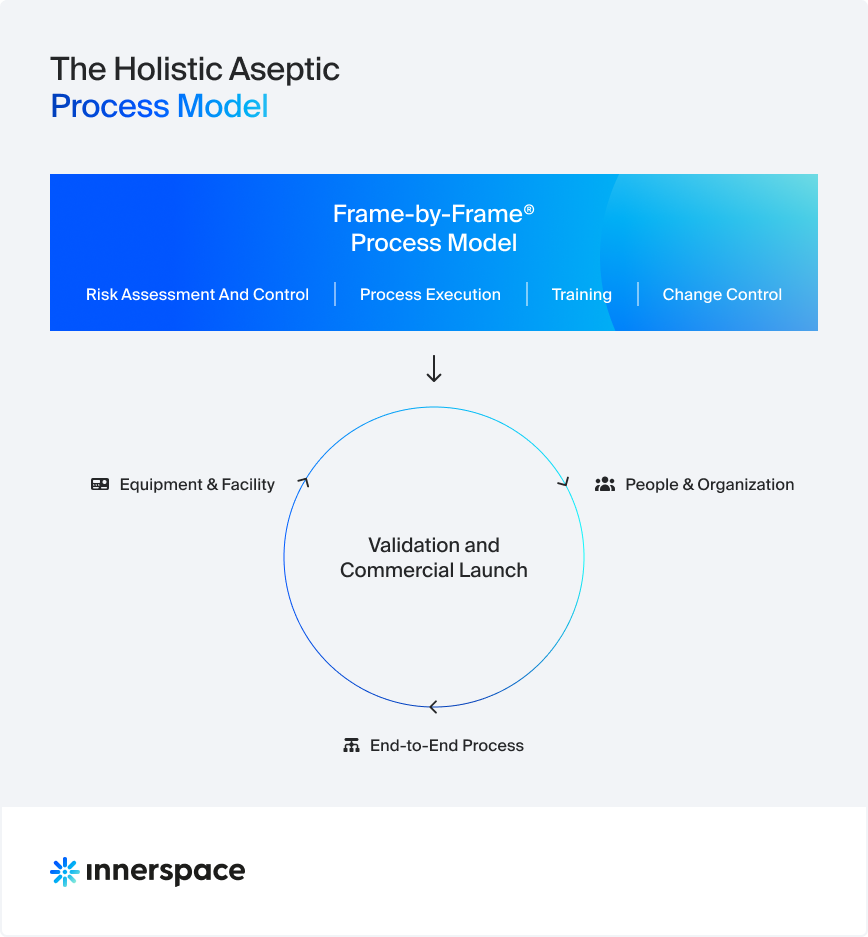
By standardizing terminologies, physical configurations, and human activities into a unified, clean taxonomy, it systematically digitizes and harmonizes what was previously trapped in binders, drawers, and memory. This is the bridge that turns “dark data” into validated operational intelligence:
- Align stakeholders: Engineering, Quality, Operations, and Training work from one consistent, shared process definition. This creates a common language across functions and reduces interpretation gaps in how operations are designed, executed, and improved.
- Identify embedded risks: Granular process modeling makes subtle, context-dependent risks in operator activities, interventions, and equipment interactions visible earlier, before they become normalized or embedded in routine behavior.
- Improve processes systematically: Process variants, bottlenecks, and improvement opportunities can be evaluated in a structured way before changes are introduced into live operations, enabling safer and more data-driven optimization.
- Standardize training and qualification: Training can be directly connected to real process activities, risks, and required controls, ensuring that qualification reflects actual operational behavior rather than abstract procedures.
- Strengthen traceability: Risk assessment and controls, process execution documents, and training remain consistently linked to the underlying process model, creating a transparent and auditable chain from process design to execution.
The objective is not to replace human expertise, but to make operational knowledge structured, traceable, and reusable in a way that enhances decision-making across the organization.
Operational Readiness should create more than a facility that is ready to run. It should establish an operational foundation that is ready to scale, transfer, improve, and evolve with confidence and consistency.
Closing: Build the Foundation Before You Scale the Intelligence
AI and advanced digital systems will increasingly become part of pharmaceutical manufacturing. But their value will depend on the operational foundation beneath them.
Organizations that use Operational Readiness to establish standardized processes, structured data, clear operational context, and capable people will be better positioned to accelerate startup, support technology transfer, improve Right First Time performance, and introduce advanced analytics and AI responsibly.
The sequence matters: Standardize first. Structure the data. Build process understanding. Then automate and scale.
Before asking “Where can we apply AI?”, leadership should first ask: “Is our operational foundation ready for it?”
Operational Readiness should give us the evidence to answer that question.
Let’s build a stronger operational foundation, frame by frame.

About Andreas Berger – CTO & Managing Director at Innerspace.
Andreas Berger is CTO, Managing Director, and one of the three Co-Founders of Innerspace, guiding the company’s technical direction. With nearly 20 years of experience in software development and more than a decade at Innerspace, Andreas has dedicated his career to bridging the gap between the complex, highly regulated demands of the pharmaceutical industry and scalable, cutting-edge digital solutions.
Under his leadership, Innerspace focuses on the true, foundational pillars of modern process digitalization: data mining, big data architectures, data science, and machine learning. Through Frame-by-Frame®, Innerspace provides global biopharmaceutical manufacturers with a standardized, compliant data infrastructure that aligns process design, equipment operation, and human behavior for safe, efficient, and compliant operations from Day One.
- Connect with Andreas Berger on LinkedIn to discuss the future of cGMP data infrastructure.
- Explore how to bring Frame-by-Frame® to your facility at Innerspace.eu.
Join pharmaceutical executives, quality managers, and manufacturing engineers who receive data-driven insights on Annex 1 compliance, human-error reduction, and digital process modeling delivered straight to their inbox.

Ready to Transform Your Aseptic Manufacturing Processes?
Stop relying on static documentation to manage complex cleanroom operations.
📥 Download our free Product Guide: “Frame-by-Frame®”
And learn how leading pharmaceutical manufacturers use data-driven process modeling to systematically analyze risks, streamline execution, and optimize training.
Frequently Asked Questions (FAQ)
In drug discovery, the digital environment is naturally highly structured and data-native, utilizing standardized genetic or biochemical databases. Conversely, aseptic manufacturing is physical, complex, and driven by human behavior. Trying to deploy “black-box” machine learning algorithms directly on the shop floor fails because regulatory authorities (like the FDA) require complete explainability and strict cGMP validation, which traditional unvalidated AI cannot provide.
“Dark data” refers to operational data—such as equipment sensor outputs, climate records, batch reports, and human cleanroom movements—that is collected but never structured, analyzed, or put to use. In biopharmaceutical manufacturing, up to 90% of data is dark. Attempting to deploy predictive analytics or AI models on an incomplete data structure leads to massive computational bias, invalidating the model.
Traditional neural networks are “black boxes”; they cannot explain how they reached a critical outcome to an FDA auditor. Frame-by-Frame® acts as the unifying intermediary layer, digitizing physical cleanroom interactions into a granular, standardized, and machine-readable framework. By connecting tangible reference materials—such as video—to a single source of truth, it creates a fully traceable link between the underlying process, its identified risks, derived documentation, and personnel training. Every insight is explainable, visual, and grounded in structured process DNA.
Annex 1 requires a truly holistic Contamination Control Strategy (CCS). With Frame-by-Frame® as a Digital Process Model, manufacturers can systematically map workflows, identify and assess critical risks, and drive actionable risk reduction. From this single source of truth, compliant documentation and effective training programs are directly derived, significantly lowering overall risk to the final product.
Generative AI models are prone to “hallucinations” – generating confident but completely inaccurate answers. In high-stakes aseptic operations where critical quality attributes (CQAs) directly affect patient safety, this risk is unacceptable. AI can only be integrated into a pharmaceutical manufacturing workflow if it is grounded in a verified, standardized, and non-hallucinating digital data foundation.
The Frame-by-Frame® Process Model allows manufacturers to systematically identify process risks and either design them out or establish targeted controls. Training forms a core part of this risk-mitigation strategy. In line with ICH Q9(R1) principles, the model enables a risk-proportional training approach: high-risk operations demand higher formality and deeper hands-on practice, while lower-risk tasks utilize leaner formats. Guided by ASTM standards, each risk point is paired with the optimal learning modality – combining clear documentation, digital e-learning, and immersive VR simulations for critical cleanroom interventions – ensuring effective, efficient qualification without wasted effort.
Sources
- AI in Pharma: Innovations and Challenges
Pharma Digital Transformations Failure & Success
Intervention of AI in Pharmaceutical Sector ↩︎ - CAI Operational Readiness Solution ↩︎
- Article: Readiness often starts too late ↩︎
- CAI Operational Readiness Framework ↩︎
- European Pharmaceutical Manufacturers bet on AI ↩︎
- Digitalisation of Pharma ↩︎
- What Annex 22 spells for AI in GMP-Manufacturing ↩︎
- EU GMP Annex 22: AI Compliance in Pharma Manufacturing ↩︎
- CAS: Pharma Data Management and Dark Data ↩︎
- FDA: Artificial Intelligence in Drug Manufacturing ↩︎
- Pharmaphorum: Garbage In, Garbage Out ↩︎
- European Commission: Draft EU GMP Annex 22 ↩︎
- ISPE: Pharma 4.0 Needs More than Technology ↩︎
- CAS: Dark Data and Knowledge Management ↩︎
- FDA: Artificial Intelligence in Drug Manufacturing
European Commission: Draft EU GMP Annex 22 ↩︎ - ISPE: Pharma 4.0 Workforce ↩︎
- FDA: Data Integrity and Compliance with Drug CGMP ↩︎