


Having spent over 20 years in the digital and software world and nearly 10 years in the pharma branch, I have witnessed several technology hypes come and go. Every wave produces its share of clear winners and losers; for every groundbreaking breakthrough, there is a trail of scorched earth left behind by rushed, uncoordinated implementations. The pharmaceutical industry is certainly not immune to this AI hype – or what might even be an impending AI bubble.
While artificial intelligence offers incredible opportunities and has already proven its value in R&D, deploying it incorrectly on the manufacturing shop floor could lead to astronomical costs and wasted resources.1
In my position at Innerspace, my ultimate goal is not to chase the next fleeting trend, but to cultivate a healthy soil – a rock-solid, standardized baseline. If we want to capture the real potential of AI in a regulated cGMP environment, we must first change how we build our data foundation. But I would like to share more about this in the following lines.2
What You Get: Key Takeaways
- Successful AI Use Cases: Learn where artificial intelligence and machine learning are already successfully deployed in pharmaceutical R&D, clinical trials, and operations.
- The Pitfall of “Headless” AI: Understand how isolated AI subscriptions and untraceable “black box” tools pose a direct threat to regulatory compliance.
- The Hidden Enemy of “Dark Data”: Discover why 40% to 90% of your operational data remains completely unused and how this undermines your AI efforts.
- Why 73% of Digital Projects Fail: A granular breakdown of the five structural reasons why most digital transformations in pharma miss their target.
- A GMP-Compliant Path Forward: How to use structured digital process models like Frame-by-Frame® to establish a reliable data infrastructure for sustainable optimization.
The High-Stakes Paradox of Pharma AI
The pharmaceutical industry is currently caught in a fascinating, high-stakes paradox. On one hand, global biopharmaceutical organizations are highly motivated to adopt cutting-edge technologies. Driven by the promise of dramatic cost reductions, rapid scale-up of novel therapies, and the dream of the self-optimizing “smart factory”, operators and executives alike are eager to implement artificial intelligence.
On the other hand, the reality of this digital frontier is sobering: approximately 7 out of 10 digital transformation projects in the pharmaceutical sector fail to achieve their intended goals. Experts are clear: there are immense chances for innovation as there are tough challenges to master.3
The reality Gap: While capital investment skyrockets, 70% of shop-floor projects fail.
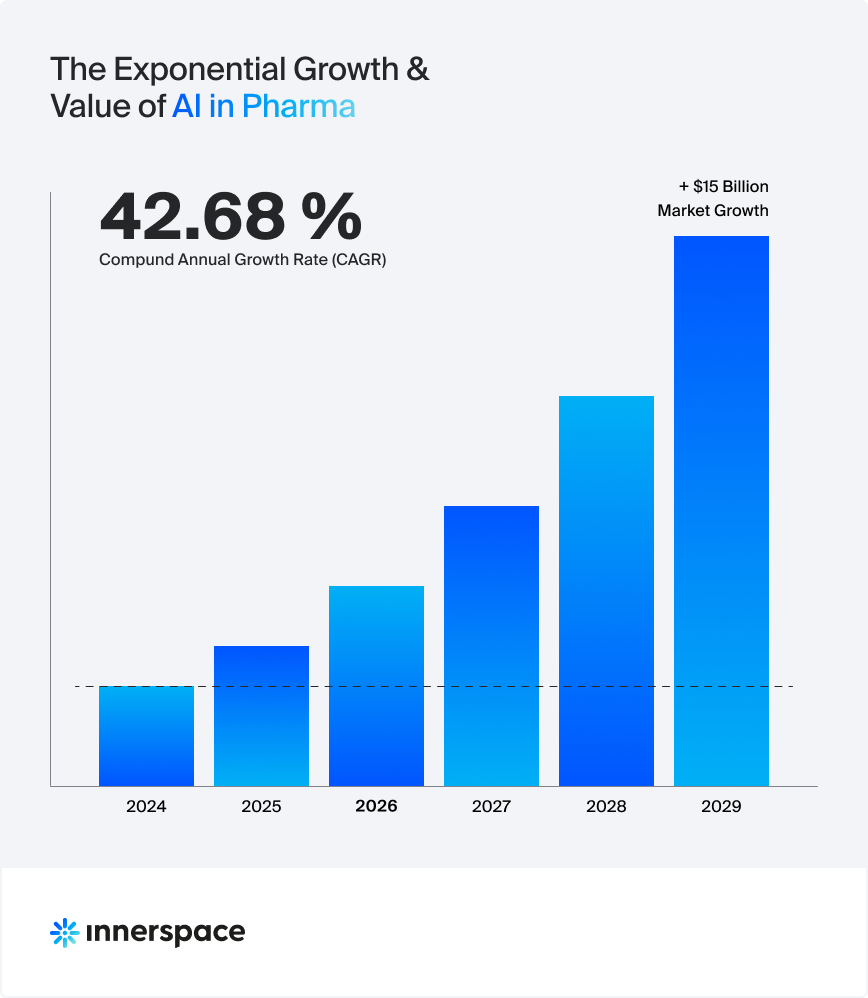
This tension between rapid technical innovation and uncompromising regulatory compliance is particularly palpable in aseptic manufacturing. Here, even a minor human error, equipment misalignment, or process deviation can threaten contamination control, leading to millions of dollars in lost batches and compromising patient safety. We want the power of AI, but we are bound by the strict laws of Current Good Manufacturing Practices (cGMP) and the need for validation.4
How do we bridge this gap? The answer does not lie in buying more software subscriptions or hoping a generic large language model will magically solve cleanroom complexities. It lies in building a standardized, structured, and reusable data foundation.
The Current Landscape of AI in Pharma
The Rise of AI in the Pharmaceutical Industry: Where It Is Already Driving Success
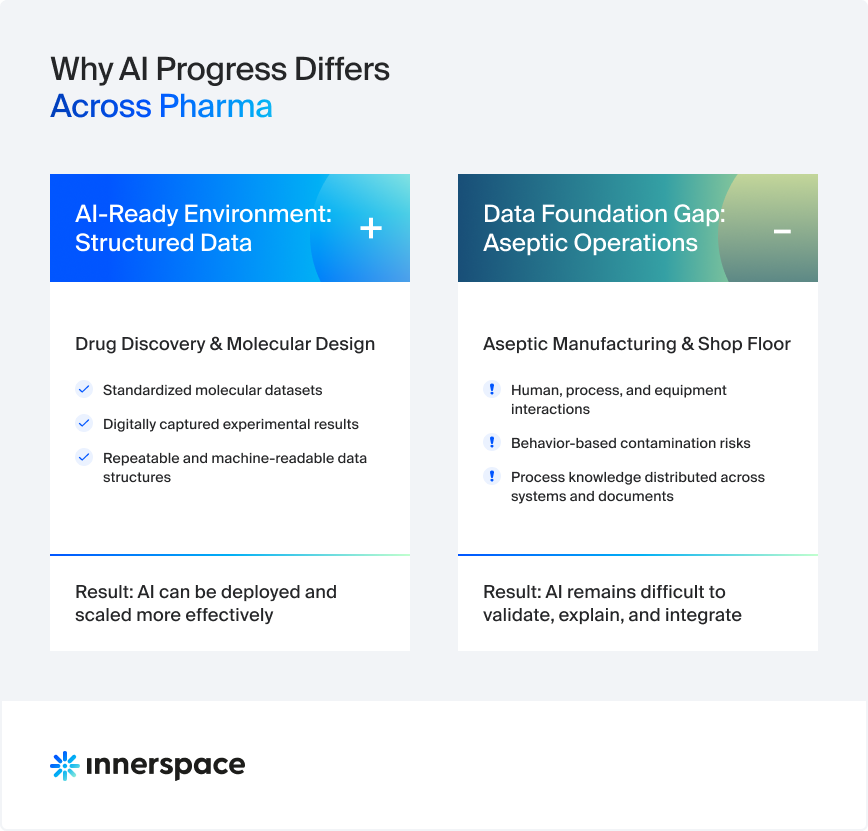
The conversational landscape around AI in pharma has shifted dramatically. Historically, the executive focus on artificial intelligence was almost exclusively confined to research and development (R&D). Today, however, pioneering pharma companies are shifting their AI focus from pure laboratory drug discovery toward commercial manufacturing operations. The reason is simple: manufacturing operations present the largest leverage point for immediate cost reduction, resource efficiency, and yield optimization.5
Wherever AI is currently succeeding in the life sciences, it shares a common denominator: a highly structured, standardized digital data foundation. From chemical engineering calculations to predictive analytics in supply chain management, machine learning models thrive when they are fed clean, consistent, and validated historical data.6
The current successful applications of AI across the pharma industry represent a diverse spectrum of capabilities:
- Drug Discovery & Molecular Design: Screening millions of molecules in silico to predict biological activity.
- Clinical Trials & Patient Recruitment: Utilizing predictive algorithms to identify and qualify ideal patient cohorts.
- Digital Process Twins: Simulating aseptic manufacturing processes to optimize flow and equipment placement before physical execution.
- Supply Chain Management Optimization: Predicting shortages of excipients and optimizing the distribution of active pharmaceutical ingredients (APIs).
- Personalized & Precision Medicine: Designing specialized treatments such as cell and gene therapies tailored to individual patient genomes.
- CRM & Commercial Operations: Streamlining customer engagement without breaking strict compliance barriers.
AI and the Reason Why Pharma is Already Benefiting Massively from its Use in Research / R&D
Research and development has become one of the most impactful application areas for artificial intelligence, particularly deep learning and neural networks. Because R&D relies heavily on structured digital data, including genomic sequences, molecular structures, biochemical assays, and target identification datasets, AI models can efficiently analyze complex information at a scale beyond traditional computational methods. Generative AI and advanced machine learning approaches are helping researchers identify promising drug candidates, optimize molecular design, and prioritize experiments, significantly accelerating early-stage drug discovery and reducing development timelines.7
AI and Its Success in Clinical Trials
AI and machine learning have emerged as powerful tools across multiple stages of drug discovery and development, particularly in accelerating target identification and molecular design through the analysis of large-scale biomedical datasets and computational screening. By integrating multi-omics data with advanced algorithms, researchers can now systematically explore vast datasets and identify novel therapeutic candidates more efficiently than traditional methods.8
Progress through AI in Cell and Gene Therapy
In the field of biological products and advanced biologics, precision is everything. Cell and gene therapies present unique manufacturing challenges due to their high product variability, limited batch sizes, and patient-specific characteristics, where traditional, rigid batch-production models fail. By enabling deeper analysis of cellular characteristics, predicting protein structures, and optimizing transduction efficiency, AI helps manufacturers better understand and control critical quality attributes (CQAs) required to ensure product safety, efficacy, and quality.
Beyond individual bioprocess optimization, AI is transforming the broader Advanced Therapy Medicinal Product (ATMP) landscape. It is increasingly used to monitor and control processes in real time, automate quality tasks, and leverage digital twins for predictive modeling. Furthermore, AI analyzes heterogeneous patient and process data to improve potency assessments and streamline logistics, compliance, and decentralized hospital manufacturing – though full realization of this potential remains dependent on robust data, validation, and evolving regulations.9
AI and Digital Process Twins for Aseptic Manufacturing
In biopharmaceutical manufacturing, particularly aseptic formulation, continuous manufacturing, and encapsulation, physical trial-and-error is prohibitively expensive. The integration of digital twins allows engineers to simulate fluid dynamics, tablet pressing, fermentation, and sterilization processes virtually. These digital process twins act as a bridge, allowing teams to simulate “what-if” scenarios, refine validation protocols, and conduct predictive maintenance on critical process equipment.10
The AI Risks: Pharma goes headless with AI – AI Subscriptions Sprawl and Black Boxes across every department
While the successes in R&D are inspiring, they have fueled a dangerous illusion on the operational side: the belief that AI can be sprinkled over any messy, legacy process to make it “smart.” In many pharmaceutical companies, we are witnessing a phenomenon known as “headless pharma.” Driven by the fear of falling behind, different departments are independently adopting fragmented, localized AI subscription services.11
This unchecked proliferation of AI solutions creates isolated information silos and massive data governance liabilities. When individual departments implement “black box” agentic AI tools or unvalidated large language models to assist with quality control, validation, or training, they introduce significant risk. If an operator relies on an unverified, non-GMP-compliant AI to interpret complex cGMP protocols or cleanroom procedures, the consequences can be catastrophic.
In my years of developing technology for this industry, I have seen many well-meaning tech implementations. But the current rush to adopt autonomous, unregulated AI agents without a standardized data foundation is uniquely alarming. It is the architectural equivalent of using a highly destructive force in a fragile environment. To put it bluntly:
“AI is only as effective as the foundation beneath it. Without standardized and structured data, it adds complexity rather than creating sustainable value.”
The AI Illusion: Why Glossy Strategy Decks Fail When It Comes to GMP Reality in aseptic manufacturing
Step into any corporate boardroom, and you will see glossy slide decks outlining millions of dollars in projected efficiency gains from “AI-driven manufacturing operations.” But step onto the actual shop floor of an aseptic facility, and you face a completely different reality. Here, strict regulatory oversight by the U.S. Food and Drug Administration (FDA) and other global authorities makes the unvalidated deployment of AI a total non-starter.12
“Working in this industry for years, one pattern has become clear to us: the same equipment and processes are often executed differently across sites and even within the same facility, supported by inconsistent procedures and training materials. At the same time, organizations are pursuing global standardization, scalability, and AI integration. Closing this gap requires a shared, structured data foundation across operations.“
In a validated cGMP environment, every single process step must be documented, reproducible, and explainable. Traditional machine learning and deep learning models operate as “black boxes” – they can output a prediction, but they cannot show their work in a way that satisfies a regulatory inspector. If a quality control system flag is based on an AI’s unexplainable algorithm, how do you defend that to an FDA auditor?
Furthermore, generative AI models are prone to “hallucinations” – generating confident but inaccurate answers – which represents an unacceptable risk profile when drafting SOPs or validation protocols.13
This problem is compounded by the issue of “dark data.” In most pharmaceutical manufacturing facilities, 40% to 90% of the data generated by sensors, equipment, and human operations is completely “dark” – it is collected but never recognized, accessed, or structured. When companies attempt to train advanced AI algorithms on this unstructured, dark data, they feed the algorithm incomplete, biased, and highly fragmented inputs. The result is not an optimized smart factory; it is an expensive, hallucinating compliance risk.14
Not AI only – Why generally 7 Out of 10 Digital Transformation Projects Fail – 5 Reasons
The failure rate of digital transformations in the pharmaceutical sector is not an anomaly; it is a direct consequence of systemic architectural mistakes. Based on industry-wide data and our extensive experience at Innerspace, these failures typically boil down to five core execution errors:15
- Tech-First Fallacy (Ignoring the Human): Organizations fall in love with the technology (e.g., buying expensive hardware/software) without considering how the human beings on the factory floor will interact with it day-to-day.
- Silo and Patchwork Architectures: Deploying disconnected software solutions in different departments, leading to fragmented databases and “headless” workflows that cannot talk to one another.
- Lack of a Unified Data Strategy: Initiating digital projects without a clear, standardized data infrastructure that defines how process data is captured, structured, and reused.
- Unprepared Workforce and Culture: Failing to bridge the gap between complex digital tools and the actual skills of the operations team, which leads to user rejection and low adoption.
- Rigid Compliance vs. Agile Tech: Attempting to force fast-moving, black-box AI tools directly into highly regulated cGMP environments without adapting the verification and validation frameworks first.
Another insightful piece by William Flaiz – a Data, AI & Decision Sciences Leader in the pharma and healthcare space – can be found here: Why 73% of Pharma Digital Transformations Fail (And How the 27% Succeed).16
Transformation Potential of Pharma Manufacturing in using Data & AI
Despite these significant challenges, the transformation potential of data-driven manufacturing remains immense. By pivoting away from localized “hype-driven” AI tools and focusing instead on building clean, structured data pipelines, companies can achieve remarkable operational excellence. The highest lever for cost reduction, process optimization, and yield improvement lies in capturing the physical reality of the cleanroom and translating it into highly structured digital intelligence.17
The industry is under pressure from rising costs, specialized therapies like biologics, and stricter contamination control guidelines (such as EU GMP Annex 1). To survive, we must optimize. But we must do so by replacing the “magic AI” illusion with highly structured, explainable, and compliant digital process models.
Digital Optimization in Aseptic Manufacturing without Compromising GMP Compliance
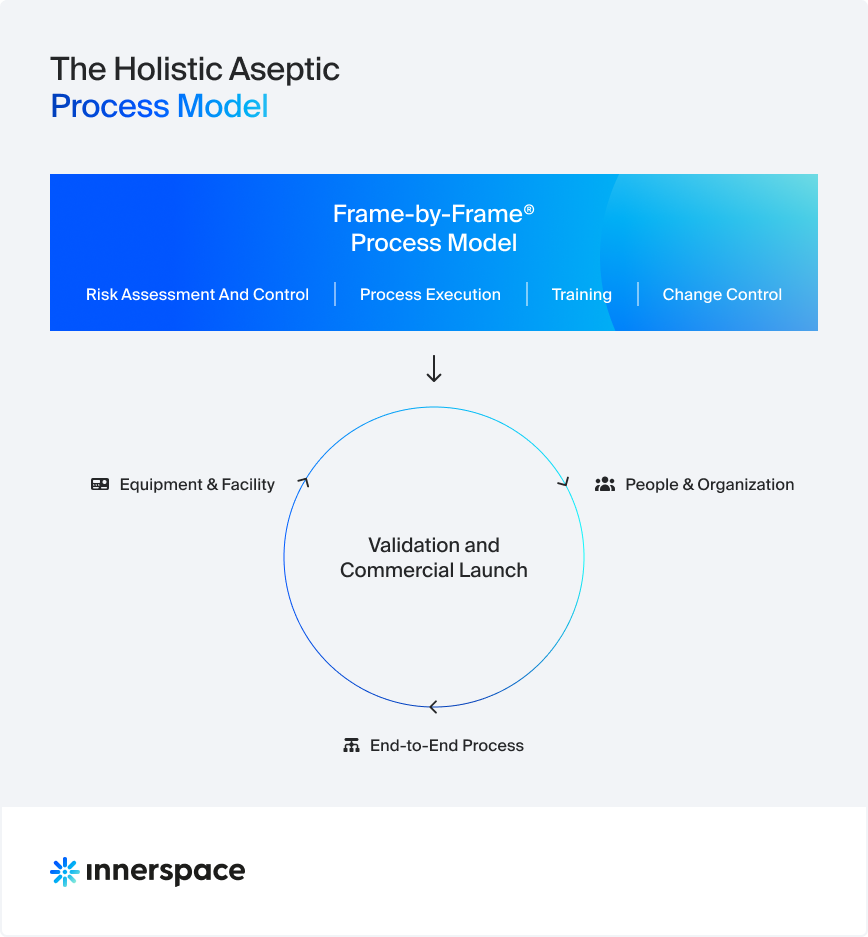
How do we actually achieve this? At Innerspace, we recognized early on that real impact in the cleanroom requires a holistic view. Our solution targets three fundamental pillars: process, equipment, and people. None of these elements can be optimized in isolation.18
To capture this interaction in a validated, compliant way, we developed our proprietary technology: Frame-by-Frame®. Instead of trying to use an unstructured, unvalidated AI to make sense of fragmented shop-floor observations, Frame-by-Frame® translates complex aseptic manufacturing operations into a highly structured, granular, tracable and reusable digital process model.19
This structured process model provides a standardized data infrastructure that allows manufacturers to:20
- Align stakeholders in one digital process foundation: Break down departmental silos by translating complex aseptic operations into a single, machine-readable truth. Engineering, quality assurance, and operations teams can align on a unified process definition, eliminating subjective debates on cleanroom behaviors and facilitating cross-site process harmonization.
- Identify and control subtle, embedded process risks: Go beyond obvious failure modes to uncover highly context-dependent, invisible behavioral habits that operators have accepted over time. Capturing precise operator movements, sterile interventions, and equipment setups highlights minor deviations before they escalate into contamination events.
- Enable targeted risk-based process improvements: Shift from reactive trouble-shooting to proactive, systemic optimization. By running precise process mining and comparing localized process variants, manufacturers can safely design and execute data-driven optimizations to both manual cleanroom flows and automated packaging or continuous manufacturing sequences.
- Train and qualify personnel in a standardized way: Replace dry, paper-based SOP reading with objective behavioral training. By linking granular process DNA directly with targeted virtual reality simulations, operators build precise muscle memory, align their physical habits with strict equipment parameters, and qualify in a traceable, highly repeatable manner.
- Ensure compliant and traceable risk reporting: Meet the uncompromising audit standards of global regulators (like the FDA and EU GMP Annex 1). Because every analytical insight and optimized step in the process model links directly back to deterministic, verifiable physical operations, risk management becomes fully transparent, visual, and audit-ready.
Closing: Building the Foundation First
We do not need to fear the future of AI in pharmaceutical manufacturing – but we must approach it with engineering discipline. If we continue to chase glossy strategy decks and implement uncoordinated, “headless” AI subscriptions, we will keep failing 7 out of 10 times.
True innovation in aseptic manufacturing comes from doing the foundational hard work first: digitalizing our physical reality, standardizing our process DNA, and building a clean, reusable data foundation. Only when we maintain a perfect, data-driven balance between process, equipment, and people can we safely lead the pharmaceutical industry into the next era of smart manufacturing.21

About Andreas Berger – CTO & Managing Director at Innerspace.
Andreas Berger is CTO and one of three Co-Founders as Managing Director at Innerspace, where he guides the company’s technical direction. With nearly 20 years of experience in software development and more than a decade at Innerspace, Andreas has dedicated his career to bridging the gap between the complex, highly regulated demands of the pharmaceutical industry and scalable, cutting-edge technological solutions.
Under his leadership, the Innerspace engineering and data teams focus on the true, foundational pillars of modern process digitalization: data mining, big data architectures, data science, and machine learnings. Through Frame-by-Frame®, Innerspace provides leading global biopharmaceutical manufacturers with a standardized data infrastructure. This goes far beyond creating static process models; it serves as a dynamic foundation to improve existing workflows or design entirely new ones from scratch.
By analyzing the cleanroom from a holistic, meta-level perspective, Andreas and his team enable companies to perfectly align, continuously retrain, and bridge the gap between process, equipment, and human behavior – all while maintaining uncompromising GMP compliance.
- Connect with Andreas on LinkedIn to discuss the future of cGMP data infrastructure.
- Explore how to bring Frame-by-Frame® by Innerspace.eu to your facility.
Join over 1,200 pharmaceutical executives, quality managers, and manufacturing engineers who receive our newsletter. Get actionable, data-driven insights on Annex 1 compliance, human-error reduction, and digital process modeling delivered straight to your inbox.

FAQ’s
In drug discovery, the digital environment is naturally highly structured and data-native, utilizing standardized genetic or biochemical databases. Conversely, aseptic manufacturing is physical, complex, and driven by human behavior. Trying to deploy “black-box” machine learning algorithms directly on the shop floor fails because regulatory authorities (like the FDA) require complete explainability and strict cGMP validation, which traditional unvalidated AI cannot provide.
“Dark data” refers to operational data—such as equipment sensor outputs, climate records, batch reports, and human cleanroom movements—that is collected but never structured, analyzed, or put to use. In biopharmaceutical manufacturing, up to 90% of data is dark. Attempting to deploy predictive analytics or AI models on an incomplete data structure leads to massive computational bias, invalidating the model.
Traditional neural networks are “black boxes”; they cannot explain how they reached a critical outcome to an FDA auditor. Frame-by-Frame® acts as an intermediary layer. It digitizes physical cleanroom interactions into a granular, standardized, and machine-readable framework. Because every data point is interconnected and directly referenced back to the underlying video footage, the data carries a highly structured ‘process DNA.’ This ensures that every automated analysis or predictive insight is fully traceable, visually verifiable, and easily explainable.
Annex 1 demands a holistic approach to Contamination Control Strategies (CCS). Using a Digital Process Model like Frame-by-Frame® allows manufacturers to systematically analyze the manufacturing process, identify and assess risks, and systematically reduce non-acceptable residual risks whenever possible. From this baseline, required documentation can be derived and made trainability-ready – effectively minimizing overall risk to the final product.
Generative AI models are prone to “hallucinations” – generating confident but often inaccurate answers. In high-stakes aseptic operations where critical quality attributes (CQAs) directly affect patient safety, this risk is unacceptable. Pharmaceutical validation requires strict determinism: the absolute guarantee that a system, given the same inputs, will always produce the exact same, predictable output. Consequently, AI can only be integrated into a manufacturing workflow if it is grounded in a verified, standardized, and deterministic digital data foundation that eliminates any room for probabilistic guesswork.
Sources
- Wikipedia – R&D Drug Development ↩︎
- FDA – Good Manufacturing Practice ↩︎
- Scilife – AI in Pharma: Innovations and Challenges ↩︎
- FDA – Good Manufacturing Practice ↩︎
- NexusConnect – Revolution and Risks of AI in Pharma
Danaher Life Sciences – AI in Drug Discovery ↩︎ - Danaher Life Sciences – AI in the Pharmaceutical Industry ↩︎
- ScienceDirect – AI Trends in Drug Discovery and Development ↩︎
- ScienceDirect – Machine Learning in Clinical Trial Design ↩︎
- Springer Nature Link – The road to faster and more efficient CAR T cell manufacturing ↩︎
- Pharma Focus Europe – Digital Twins in Pharmaceutical Manufacturing ↩︎
- Dr. Dennis Janning via LinkedIn – Headless Pharma & Tech Sprawl ↩︎
- Danaher Life Sciences – Navigating AI Implementation Barriers ↩︎
- GMP Compliance – AI and Hallucinations in the GMP Environment ↩︎
- Fierce Pharma – 5 Common Mistakes That Risk Your Pharma AI Efforts ↩︎
- Mendix – Why Transformations Fail
ScienceDirect – Industrial Digital Transformation Studies ↩︎ - Why 73% of Pharma Digital Transformations Fail ↩︎
- NexusConnect – Digital Transformation and Efficiency Gains in Manufacturing ↩︎
- Life Sciences – Operational Readiness Framework from CAI ↩︎
- Innerspace – The Digital Process Model Foundation ↩︎
- Pharma Focus Europe – Advanced Digital Process Models and Optimization
Innerspace.eu ↩︎ - Pharma AI Pilots: Fixing Data Foundations for Scale ↩︎